If you have been comparing tint shades you will have seen 30% listed by some installers and not by others. It sits in the gap between the two most common numbers on the board, and whether you can actually get it depends on which film line you are buying.
30% is the lighter of the two. It passes 30% of visible light and reads as a moderate tint that still works well at night.
20% passes 20% and is the stronger privacy shade, clearly aftermarket on most cars.
One thing to know before you shop: Smith Bros stocks its GeoShield films in 70%, 50%, 35%, 20% and 5%. We do not list a 30% option, so for us the equivalent comparison is 35% against 20%.
What the window tint percentage means, and why 30% appears on some menus
Both figures are VLT numbers. Visible light transmission is the share of light the film passes, so window tint percentages read backwards from what people expect: the lower the number, the darker the glass. A 30 percent film lets through 30% of the amount of light hitting it; a 20 percent film lets through 20%.
Two things the percentage does not tell you. It says nothing about heat, which is set by the film’s construction rather than its darkness, and nothing about UV rays, which every quality film blocks at 99% regardless of shade. A cheap dyed tint at 20% will let more heat into the cabin than a good ceramic at 35%.
Window film is manufactured in standard shades, and which ones a shop carries depends on the brand and line it has chosen to install. There is no universal set. One manufacturer’s range might run 5, 15, 20, 35, 50, 70; another’s might include 30 and skip 35.
That is the entire reason this comparison is awkward. 30% and 35% are five points apart, which is close to indistinguishable in normal light, but they belong to different product ranges.
We install GeoShield, stocked in 70%, 50%, 35%, 20% and 5%. If you arrive asking for 30%, what we will do is hold a 35% sample against your glass so you can see it on your own car in daylight. In practice that settles it for nearly everyone, because the half-step between 30 and 35 is not something the eye picks up without the two side by side.
What we will not do is tell you a 35% film is a 30% film. If 30% specifically matters to you, for instance because you are matching an existing installation done elsewhere, say so when you book and we will be straight with you about what we can match.
30% vs 20% compared
| 30% tint | 20% tint | |
|---|---|---|
| Light blocked | 70% | 80% |
| Appearance | Moderate tint, still reads as glass | Strong tint, clearly aftermarket |
| Daytime privacy | Interior partly obscured | Interior hard to read |
| Night visibility | Good, minor reduction | Noticeably reduced |
| Suits a first-time tint | Yes | Yes, with more adjustment |
| Legal behind the driver in CA | Yes | Yes |
| Legal on front sides in CA | No | No |
| Available at Smith Bros | No, 35% is the nearest | Yes |
Where 35% fits in
Since 35% is what we actually install in this part of the range, it is worth placing it properly.
| Shade | Light blocked | Stocked by Smith Bros |
|---|---|---|
| 50% | 50% | Yes |
| 35% | 65% | Yes |
| 30% | 70% | No |
| 20% | 80% | Yes |
35% blocks 65% of light against 30%‘s 70%. The practical difference is five percentage points of transmitted light, which is far smaller than the difference between either of them and 20%. If you were choosing 30% because you wanted privacy without committing to a dark car, 35% delivers the same thing. We compare it directly with the darker option in 20 window tint vs 35.
Night driving, which is where the real gap is
Between 30% and 20% there is a genuine, noticeable difference after dark.
At 30% most drivers report no meaningful change to how they drive at night. Reversing is normal, blind spot checks are normal.
At 20% you will notice, particularly reversing out of an unlit driveway or picking a cyclist out of a dark side street. It is a shade people adapt to comfortably within a week or two, but the adaptation is real and it is the single most common reason someone comes back wanting to go lighter.
This is the axis on which to make the decision. Privacy at 20 percent is better. Night visibility at 30 percent or 35% is better. There is no tint that gives you both.
Choosing the right window tint here is really a question about how you use the car after dark, not about how it looks in daylight. Get that part right and the rest follows.
Heat is decided elsewhere
If you are weighing these two shades for a cooler cabin, the shade is not the lever.
| Package | Film | Heat rejection | UV rejection |
|---|---|---|---|
| Bronze Carbon Tint | GeoShield C2 Carbon | 50% | 99% |
| Silver Ceramic Tint | GeoShield Pro Nano Ceramic | 76% | 99% |
| Gold Ceramic Tint | GeoShield Apex Ultra Ceramic | 95% | 99% |
Those figures hold at every shade in the range. A 35% Apex Ultra rejects up to 95% of heat while looking considerably lighter than a 20% carbon film that rejects half that. Every line blocks 99% of UV regardless of darkness. The full explanation of why construction beats darkness is in ceramic tint vs regular tint.
The California constraint, briefly
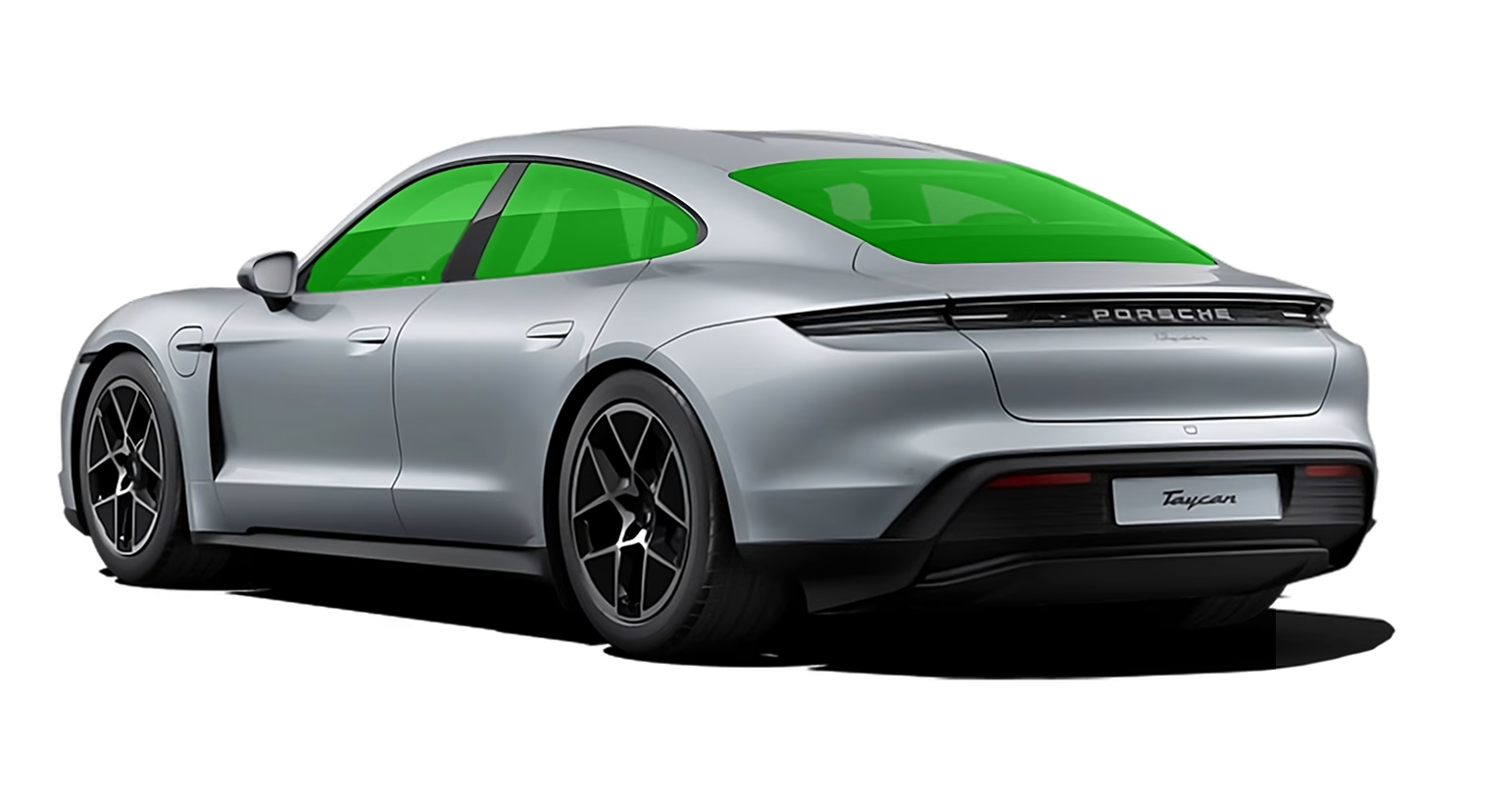
Neither shade in this comparison is legal on the front windows. California requires the front side windows to allow more than 70% light transmission, measured with the factory glass included, and factory glass already absorbs some light on its own.
Behind the driver, any darkness is permitted provided the vehicle has both working side mirrors. So 30%, 35%, 20% and 5% are all fine on the rear windows, including the back windows and rear windshield.
Both shades also reduce glare from low sunlight, which is the benefit drivers notice first on an afternoon commute, and both block the same 99% of UV rays. Legality is the one place they behave identically too: local laws here are state laws, and California does not vary them by county, so what applies in San Diego applies in Riverside.
State law is enforced by meter at the roadside, and you can get a ticket for film that is too dark on the front glass even if the car came to you that way. The detail is covered in is 20% tint legal in San Diego. Check current California requirements before choosing a tint level.
Whichever you choose, the film also protects what is inside the vehicle: seats, dash and trim all age faster without it. Any car window facing the sun for a few San Diego summers shows the difference.
Local regulations are worth a last word. Because tint rules are set at state level rather than by city, the right tint for a car registered in San Diego is the right tint anywhere in California, but the rules do get amended, so confirm before you book rather than after.
Who should choose what
If you wanted 30% for a moderate look: ask for 35%. It is the nearest thing we stock, five points lighter, and virtually indistinguishable once installed.
If you wanted 30% as a compromise toward privacy: look properly at 20% instead. The compromise shade rarely satisfies someone whose actual goal was privacy, and 20% is the shade that delivers it.
If you are matching an existing 30% installation: tell us before booking. Matching film across brands is not always possible and we would rather say so up front than hand you a mismatched car.
If heat was the real motivation: choose the film line, take 35% or even 50%, and enjoy a cooler cabin and a car you can see out of at night.
What it costs
Shade does not affect price. Within each package your choice of film shade is included, so the decision costs you nothing either way.
Bronze Carbon is $249 to $399 by vehicle size, Silver Ceramic $349 to $499, Gold Ceramic $549 to $699, each covering all windows except the front windshield and sunroof. Silver and Gold carry a lifetime film warranty; Bronze carries three years and is shop-only. Full pricing lives on the mobile window tinting page.
The short version
On 30 vs 20 tint, 30% is the lighter, easier shade and 20% is the privacy shade, and the honest headline is that the gap between them matters far more at night than in the sun.
For a Smith Bros installation the practical choice is 35% against 20%, because 35% is what we stock in that part of the range and 30% is not. We will not sell you one as the other. Bring the car, or let us bring the samples to it, and the decision usually makes itself in about a minute of daylight.
We install throughout San Diego County. Call (760) 310-1532 or book online.
This article is general information, not legal advice. Check current California requirements with the DMV or CHP before choosing a tint level.